
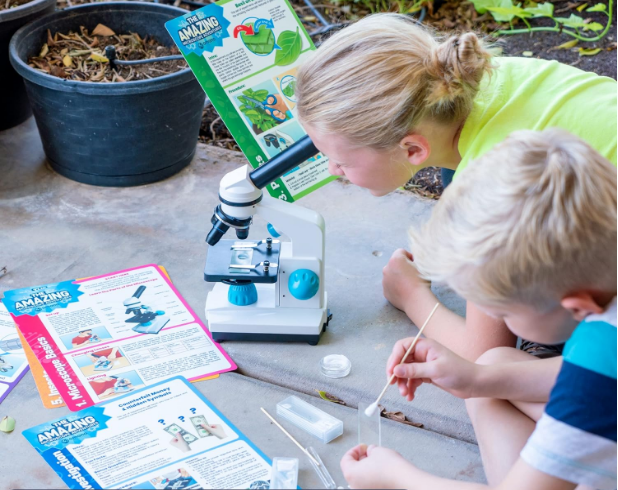
Exploring the microscopic world is one of the most exciting ways for kids to learn about science. This is where the best microscopes for kids come in handy.
The right microscope turns curiosity into real discovery. But with so many options out there, it can be hard to know which one is best for your child’s age, interests, and skill level. In this buying guide, we’ll highlight the best microscopes for kids available today, explain the features that matter most, and help you choose a model that’s both fun and educational.
What is a Microscope?
A microscope is a scientific instrument used to magnify very small objects so they can be seen more clearly with the human eye. It works by using lenses and light to enlarge tiny details that are otherwise invisible or difficult to observe.
Microscopes are commonly used to study things like insects, plant cells, fabric fibers, and microorganisms, making them very useful for learning and scientific exploration. For kids, they are great tools for sparking curiosity and introducing basic science concepts in a fun, hands-on way.
Why Kids Should Use Microscopes
Introducing children to microscopes is a great way to nurture curiosity and a love for science from an early age. Using a microscope helps kids develop observation skills by encouraging them to look closely at details they might otherwise overlook in everyday objects like leaves, sand, or insects. It also supports hands-on learning, allowing children to explore science concepts beyond textbooks.
Benefits for Learning and Curiosity
Learning and curiosity are beneficial to kids in these ways:
- Encourages exploration and discovery. Microscopes allow kids to observe tiny details in objects like leaves, water droplets, or small organisms, making science more interesting and practical. This helps nurture curiosity in the spirit of early microscopy work by Anton van Leeuwenhoek.
- Supports science learning. Children better understand basic biology and natural science concepts by seeing real specimens rather than only reading about them in books.
- Improves critical thinking. Furthermore, kids learn to ask questions, make observations, and try to understand what they are seeing under magnification.
- Develops patience and focus. Adjusting focus and studying microscopic details requires careful attention, helping improve concentration.
- Enhances hands-on learning. Furthermore, the best microscopes for kids make learning interactive, turning abstract science ideas into exciting, practical experiences.
- Boosts problem-solving skills. Last but not least, observing and interpreting microscopic images encourages logical thinking and exploration.
Types of Microscopes for Kids
Microscopes for kids fall under these three types:
- Light Microscopes. These are the most common and beginner-friendly. They use natural or built-in light to view thin or transparent samples like onion cells or water organisms.
- Digital Microscopes. These connect to a computer or screen and display magnified images digitally, making them fun and easy for children to use.
- Toy or Starter Microscopes. Designed specifically for young kids, these microscopes are simple, safe, and usually come with sample slides and accessories.
Best Microscopes for Kids
1.AmScope 52-pcs Microscope STEM Kit

The AmScope M30 Series 52-Piece STEM Microscope Kit is the best microscope for kids. It is a complete set that introduces the fascinating world of microscopy, helping to spark an interest in science.
Setting it up is intuitive, even if you’ve never used a microscope before. The knobs and slide clips are easy to understand, and the range of magnification from 120X up to 1200X lets kids see everything from plant cells to tiny insects.
The 52 pieces, including prepared slides, blank slides, and tools, give you lots of opportunities to experiment right away without having to buy extra accessories. Moreover, the built-in illuminator makes viewing clear even in dim light.
In everyday use, this microscope performs impressively for the price. Focusing is surprisingly smooth, and the lenses produce bright, detailed images when properly adjusted. It’s a great way to learn basic slide preparation and observation techniques.
Features
- 52-piece microscope kit
- Durable and stand-resistant metal frame
- Adjustable illumination
- Built-in rotating wheel with four different color filters
Pros
- Wide magnification range suitable for many specimens
- Comes with lots of accessories to get started immediately
- Easy to use and great for beginners and students
- Built-in adjustable lighting helps with clear viewing
- Sturdy construction for regular handling
Cons
- The accessories are basic and wear with heavy use
2.Omano Juniorscope Microscope for Kids

The Omano Juniorscope Microscope for Kids is a beginner-friendly educational microscope designed to introduce children to the world of science and microscopic exploration.
Built with simplicity and safety in mind, this microscope features sturdy construction and user-oriented controls that make it suitable for young learners who are just starting to explore biology and basic specimen observation.
Furthermore, the optical system delivers reasonable clarity for educational purposes, allowing kids to view prepared slides, small insects, plant cells, and other simple samples without needing advanced technical adjustments.
Its lightweight body and compact design also make it easy for children to handle, carry, and set up under minimal supervision. This supports independent learning and curiosity-driven exploration.
This microscope is also valuable as an entry-level learning tool rather than a professional scientific instrument. The magnification range is sufficient for introducing foundational concepts such as structure observation and basic scientific discovery.
Above all, the focusing mechanism is generally straightforward, helping children practice hand-eye coordination while learning how microscopes work.
Features
- High-quality glass objective lenses
- 40 100 and 400x magnification levels
- Battery-powered
- Adjustable LED lighting
Pros
- Lightweight and portable design suitable for kids
- Easy-to-use focusing controls for beginners
- Durable construction that can withstand gentle handling
- Safe optics and simple operation for young users
- Affordable entry-level science learning tool
Cons
- Limited magnification compared to advanced microscopes
3.NATIONAL GEOGRAPHIC Microscope for Kids

National Geographic offers a beginner-friendly science experience with the National Geographic Microscope for Kids, designed to introduce young learners to the basics of microscopic exploration.
This microscope is built with children in mind, featuring simplified controls, durable construction, and pre-prepared slides that help kids start observing quickly without feeling overwhelmed.
The optics provide reasonable clarity for a toy-level educational instrument, allowing children to see basic cellular structures, fabric fibers, and small organisms engagingly.
While it is not meant for advanced scientific work, it serves as an excellent gateway tool for sparking curiosity in science and discovery. Besides, the bright, child-friendly design combined with educational accessories makes learning feel more like play than study, which is ideal for younger users just beginning their science journey.
Above all, the science kit is lightweight and easy for small hands to handle, and the included experiment materials extend the learning experience beyond simple viewing
Features
- Large focus knobs
- Soft-touch eyepiece
- Adjustable platform
- Variable magnification
Pros
- Kid-friendly, simple controls make it easy to use
- Durable construction suitable for young learners
- Includes educational slides and experiment materials
- Lightweight and portable design
- Encourages interest in science and discovery
Cons
- Limited optical clarity
4.Uarzt 58-Piece Kids Microscope Kit

If you are looking for a kids’ microscope kit that encourages exploration, builds scientific interest, and supports early science education, the Uarzt 58-Piece Kids Microscope Kit is an ideal option.
It is perfect for family time and playtime, offering a fun and educational activity that can be enjoyed by all ages.
With magnification levels ranging from 100X to 1200X, the kit allows young learners to observe simple biological specimens, plant structures, and other tiny details that are often invisible to the naked eye.
Furthermore, the package typically includes prepared slides, blank slides, collecting tools, and basic accessories that help children start experimenting immediately. Its lightweight plastic construction makes it easy for kids to handle, while the bright design adds an element of fun to learning.
Performance-wise, the microscope provides decent clarity at lower magnification settings, which is suitable for educational use rather than professional scientific observation. Like many entry-level children’s microscopes, image sharpness may decrease at the highest magnification levels, and proper lighting is important for optimal viewing.
Features
- 44 pieces, including 13 randomly selected specimens and 31 blank slides
- Built-in LED light
- 200X, 400X and 1200X magnification
- Metal arm body type
Pros
- Easy to assemble and use, making it suitable for kids and beginners
- Wide magnification range
- Comes with multiple accessories, including slides and collection tools
- Lightweight and portable design enhances usability
- Encourages STEM learning and curiosity in children
Cons
- Image quality declines at maximum magnification
5.BEBANG 1000X Handheld Microscope for Kids

As one of the best microscopes for kids, the BEBANG 1000X Handheld Microscope is perfect for budding scientists aged 8-12.
It is solid and easy to grip, with a comfortable shape that fits small hands well. The focus wheel is smooth and not too sensitive, so kids don’t have to struggle to get a clear view.
At up to 1000x magnification, this microscope makes it possible to explore everything from leaf veins and fabric threads to small insects and crystals. Besides, the built-in LED lights are a big plus, providing bright and adjustable illumination that makes details pop even in dim lighting.
The fact that it’s handheld gives kids the freedom to investigate wherever they find something interesting on a walk outside, in the backyard, or just at the kitchen table. Battery life is also decent, though you’ll want to keep a few extra batteries around if your child uses it frequently.
Features
- 100-1000X zoom
- 4K clarity on a 2″ adjustable screen
- anti-glare LCD
- 0-90° tilt
- 1080p detail
Pros
- Easy for kids to hold and use
- High magnification for detailed views
- Bright, adjustable LED lighting
- Encourages curiosity and hands-on learning
- Includes useful starter accessories
Cons
- Battery-powered, so replacements are needed
6.Carson MicroBrite Plus Pocket Microscope

The Carson MicroBrite Plus 60x-120x is engineered and tested to provide truly accurate magnification, 120x optical zoom, and reliable performance you can trust.
This pocket microscope is compact and lightweight, making it the perfect educational toy for portable use as a field microscope or classroom lab microscope.
Moreover, you can add this STEM toy to any classroom science kit to bring educational content to life. It is designed to encourage hands-on exploration and a deeper understanding of the natural world
Regarding illumination, the built-in advanced light system of this handheld microscope for kids evenly shines bright LED light onto the specimen to provide clear vision and accurate observations.
Above all, the versatile magnification range of 60x to 120x makes it easy to adapt to any experiment, providing stunning accuracy and precision when viewing prepared microscope slides or everyday objects under the microscope.
Features
- Compact pocket-sized design for easy portability
- Adjustable magnification ranging from 60× to 120×
- Built-in LED illumination for enhanced viewing in low-light conditions
- User-friendly focusing mechanism for quick adjustments
Pros
- Extremely portable and lightweight for travel or field use
- Built-in LED illumination improves visibility in low-light situations
- Simple operation suitable for beginners and students
- Affordable entry-level microscope option
Cons
- High magnification makes images shaky without a stable hand or stand
7.Foldscope AQUAZA Portable Paper Microscope

Next, we have the Foldscope AQUAZA Portable Paper Microscope with 140x Magnification.
This is an ultra-lightweight educational microscope designed to bring basic microscopic observation into the hands of students, hobbyists, and field explorers.
It is built using durable paper-based components and a simple optical assembly that offers about 140x magnification. This zoom range is sufficient for viewing basic biological samples such as plant cells, microorganisms in water droplets, and small specimen structures.
Furthermore, its compact design makes it highly travel-friendly, fitting easily into a notebook or pocket, which is especially useful for outdoor learning, school projects, or introductory science exploration.
The device also prioritizes accessibility and affordability over advanced optical precision, making it an excellent entry-level tool for beginners who want to experience microscopy without investing in bulky laboratory equipment.
Features
- 140x optical magnification
- Portable paper-based design
- Simple assembly mechanism
- Educational STEM learning tool
Pros
- Affordable and accessible for students and beginners
- Extremely lightweight and highly portable
- Simple assembly suitable for educational use
- Adequate 140x magnification for basic specimen viewing
- Encourages hands-on science learning
Cons
- Limited optical clarity compared to glass-lens laboratory microscopes
8.DOUBLE CC Kids Microscope

The DOUBLE CC Kids Microscope 40-1600x Kit is our last recommendation for the best microscopes for kids.
With magnification levels ranging from 40x up to 1600x, this beginner-friendly kit offers impressive optical flexibility for a kids’ learning tool. The microscope also includes accessories such as prepared slides, blank slides, and tweezers that make it easier for young users to observe everyday samples like plant cells, dust particles, or small fibers.
Furthermore, the build is lightweight and portable, which helps children handle it comfortably under supervision. The optical clarity is also decent for educational purposes, though it may not match professional laboratory microscopes.
In terms of performance, this microscope serves well as an entry-level science learning instrument rather than a high-precision research tool. The adjustable LED illumination helps improve visibility when observing transparent or low-contrast specimens, and the focus system is simple enough for children to learn basic adjustment skills without frustration.
Features
- 40-1600x magnification
- Dual LED illumination
- Complete starter science kit
- Easy focus adjustment system
Pros
- Wide magnification range
- Lightweight and kid-friendly design
- Includes useful starter accessories for beginners
- LED lighting improves sample visibility
- Simple controls help children learn microscopy basics
Cons
- The high magnification levels produce less sharp images
Read Also:
Factors to Consider when Choosing the Best Microscopes for Kids
Magnification Power
One of the most important factors to consider when choosing a microscope for kids is magnification power. A good kids’ microscope should offer enough zoom to help children explore tiny objects like plant cells, insects, or fibers without being too complex to operate. Many beginner models provide multiple magnification levels, typically ranging from 40x to 400x, which is sufficient for educational exploration
Ease of Use
The best microscopes for kids should be simple to operate. Look for models with large focus knobs, easy slide placement, and minimal complicated settings. Children should be able to adjust focus and lighting without constant adult assistance. Avoid microscopes with overly technical controls that may discourage young learners.
Build Quality and Durability
Since children may handle equipment less gently than adults, durability is essential. Choose microscopes made from sturdy plastic or lightweight metal that can withstand accidental drops or rough handling. Furthermore, a stable base also helps prevent tipping during use.
Lighting System
Next, good illumination is crucial for clear viewing. Many kids’ microscopes use LED lighting because it is bright, energy-efficient, and safe to use. Some models offer both top and bottom lighting, which helps when observing different types of specimens. Proper lighting improves image clarity and makes learning more enjoyable, especially when studying small or transparent objects.
Educational Accessories
Many of the best microscopes for kids come with starter kits that include prepared slides, blank slides, tweezers, and specimen collection tools. These accessories make learning more interactive and exciting. A microscope package that includes educational materials helps children begin exploring science immediately without needing to purchase additional items.
Safety Features
Furthermore, safety should be a priority when selecting a microscope for kids. Look for rounded edges, non-toxic materials, and secure battery compartments. Cordless models are often safer for younger children since they reduce the risk of electrical accidents. Parental supervision is also recommended during use, especially for younger kids.
Price and Value for Money
Lastly, the best microscopes for kids are available in a wide price range, so it is important to choose one that balances quality and affordability. Very cheap microscopes may have poor optics and weak construction, while extremely expensive models may have advanced features that children may not fully utilize. Selecting a reasonably priced microscope with good durability, clear optics, and useful accessories provides the best overall value.
Best Microscopes for Kids FAQs
- What magnification is best for kids’ microscopes?
For children, microscopes with magnification levels between 40x and 400x are usually ideal. This range allows kids to observe basic biological and everyday specimens clearly without making focusing too complicated. Extremely high magnification is not necessary for beginner learning, as it makes the image shaky or unclear.
- Are LED microscopes better for kids?
Yes, LED microscopes are generally better for kids because they provide bright, consistent illumination while consuming less power. LED lights are also safer since they generate less heat compared to traditional bulbs, making them more comfortable and safer for young users.
- What age is appropriate for using a kids’ microscope?
Kids’ microscopes are typically suitable for children aged 6 years and above, depending on the model’s complexity. Younger 6-7-year-old children may need adult supervision, while older kids of 8 years and above can use basic microscopes independently.
Final Words
Investing in the best microscope for kids is an excellent way to encourage curiosity and a love for science from an early age. By focusing on factors such as magnification power, ease of use, durability, lighting quality, accessories, safety features, and overall value, you will find a model that suits your child’s learning level. Hopefully, this buying guide has steered you in the right direction.