

Our guide for best binoculars for stargazing can really be one of the best ways to dive into the wonders of the night sky. Unlike telescopes, which can be a bit cumbersome, binoculars are super portable and user-friendly. This makes them great for everyone, whether you’re just starting out or you’ve been into astronomy for years.
With a good pair of binoculars, you can catch amazing views of the Moon, check out planets, and even spot star clusters or those faint deep-sky objects that seem so far away. But, hey, when it comes to picking the right binoculars for your stargazing adventures, there are a few things you definitely want to think about.
You’ll want to look at magnification, the size of the objective lens, the optical quality, and let’s not forget about how comfortable they feel in your hands. So without further ado, lets get started.
Best Binoculars for Stargazing
1.Celestron SkyMaster 25×70

If you’re into stargazing, the Celestron SkyMaster 25×70 is one of the best binoculars for stargazing. With 25× magnification and those hefty 70 mm objective lenses, you’ll get fantastic reach and brightness; perfect for spotting planets, the Moon, and even deep-sky wonders like star clusters and galaxies.
These binoculars are on the larger side and have that high magnification, it’s really best to use them with a tripod. Luckily, Celestron has you covered with a handy ¼”-20 tripod adapter that makes mounting super easy. You’ll have a solid setup whether you’re checking out Jupiter’s colorful bands, Saturn’s beautiful rings, or the dense star fields of the Milky Way.
The SkyMaster 25×70 also comes with BaK-4 prisms, which really help in maximizing light transmission. This means you’ll get bright and sharp images, even when the light isn’t great. Their large aperture really helps make dim celestial objects pop in comparison to regular binoculars.
The rubber-armored housing gives you a solid grip and protects against bumps, plus it’s water-resistant. Celestron backs this model with a Limited Lifetime Warranty and U.S.-based customer support.
Pros
- Powerful 25× magnification for detailed views of planets and deep-sky objects
- Massive 70 mm objective lenses for excellent light-gathering ability
- BaK-4 prisms provide bright, sharp images in low-light conditions
- Tripod adaptable with an included ¼”-20 adapter for stability
- Durable, rubber-armored, and water-resistant housing
- Backed by Celestron’s Limited Lifetime Warranty and expert support
Cons
- Heavy and bulky; not ideal for handheld use
2.Orion Giant View 15×70

If you’re into stargazing, the Orion Giant View 15×70 binoculars might just be what you’re looking for. They strike a nice balance between power, brightness, and a wide field of view. With 15× magnification and those generous 70 mm objective lenses, you’ll get some seriously sharp, detailed views of the night sky.
Orion throws in their Paragon HD-F2 Heavy Duty Tripod with these binoculars, which is a smart move. This tripod is built tough with sturdy aluminum legs and solid locking clamps. It features a two-way fluid pan head, which makes it easy to follow celestial objects as they drift.
Plus, there’s an adjustable 11-inch handle and a built-in bubble level for that extra touch of precision. The feet are convertible too, so whether you’re on rocky ground or just chilling on your balcony, you’re covered.
The BaK-4 prisms and fully multi-coated lenses really step it up, enhancing brightness and contrast. Even when the skies are darker, you’ll be treated to clear images of celestial wonders. These features help cut down on glare and boost light transmission, so you can enjoy those fine details of planets and even catch glimpses of faint deep-sky objects.
While they’re primarily made for astronomy, the Orion Giant View 15×70 binoculars also do a great job during the day; perfect for birdwatching, wildlife spotting, or just soaking in beautiful landscapes.
Pros
- Large 70 mm objective lenses provide excellent light gathering
- 15× magnification offers bright, high-power views with a wide field of view
- BaK-4 prisms and fully multi-coated optics for sharp, high-contrast images
- Includes Paragon HD-F2 tripod for stable, comfortable stargazing
- Smooth, precise panning with a fluid pan head and adjustable handle
- Versatile use ; great for both astronomy and daytime terrestrial viewing
Cons
- Bulkier setup compared to smaller binoculars
3.Nikon Aculon A211 10×50
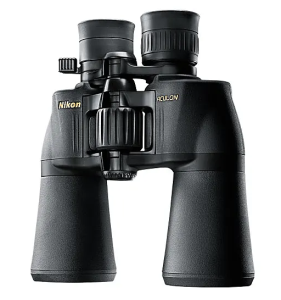
The Nikon Aculon A211 10×50 is a fantastic option. With its 10× magnification and 50 mm objective lenses, you’re in for some bright, crystal-clear views of the night sky. It’s compact, so it fits nicely in your hands, and trust me, you won’t find yourself getting tired too quickly during those longer sessions of gazing up at the stars.
Plus, those Turn-and-Slide Rubber Eyecups let you adjust the eyepiece for the perfect fit, whether you’ve got glasses on or not. Let’s not forget about the central focus knob. It’s smooth as making it easy to lock in that sharp focus on anything from stars to planets and even the Moon.
They come with aspherical multicoated Eco-Glass lenses that boost brightness and clarity, no matter the lighting. Whether you’re out at twilight or gazing into a darker sky, they hold their own. And hey, they’re not just for night adventures! You can also use them during the day for birdwatching, hikes, or even at sporting events.
The rubber-armored coating gives you a secure grip, even if things get a bit wet or humid. The Nikon Aculon A211 10×50 really nails the balance between power, portability, and ease of use. That’s why they’re such a popular choice for beginners and casual users alike.
Pros
- Lightweight and well-balanced design; easy to hold for long sessions
- 10× magnification with 50 mm lenses offers bright, clear views
- Aspherical multicoated Eco-Glass lenses deliver sharp, high-contrast images
- Turn-and-Slide Rubber Eyecups for comfortable extended viewing
- Smooth central focus knob makes adjustments quick and simple
- Durable rubber-armored coating provides a secure, non-slip grip
Cons
- Not as powerful as higher magnification astronomy binoculars
4.Vortex Viper HD 12×50

The Vortex Viper HD 12×50 binoculars, which come next, have excellent optics and an easy-to-use design. The 12× magnification and 50 mm objective lenses provide an optimal balance of detail and brightness. So, whether you’re peering at the Moon, planets, or sweeping star fields, you’re in for some crisp, clear views.
The Viper HD gives you amazing resolution and edge-to-edge clarity due to the high-density optical system. Plus, with XR anti-reflective lens coatings, you’ll enjoy maximum brightness, even when the light isn’t great. This is perfect for those early mornings, twilight sessions, or late-night stargazing.
These binoculars are designed with a rubber-armored chassis, they really help you grip them comfortably. The twist-up eyecups and generous eye relief make a huge difference during those long viewing sessions. Plus, you’ve got the locking right-eye diopter and a smooth center focus wheel to help you dial in that crystal-clear view in no time.
The Viper HD is built tough, featuring argon purging and o-ring seals that make them both waterproof and fogproof. And don’t forget about the Armortek lens protection, which keeps scratches, oil, and dirt from ruining your view.
Pros
- 12× magnification and 50 mm lenses provide detailed, bright stargazing views
- High-density optical system ensures superb resolution and edge-to-edge clarity
- XR anti-reflective coatings maximize brightness in low-light conditions
- Durable rubber-armored chassis with ergonomic grip design
- Waterproof, fogproof, and scratch-resistant for all-weather reliability
- Locking diopter and smooth focus wheel for precise, customizable focusing
- GlassPak Chest Harness included for comfort and easy carrying
Cons
- More expensive than entry-level stargazing binoculars
5.Celestron SkyMaster Pro 20×80

If you’re really into stargazing, you might want to check out the Celestron SkyMaster Pro 20×80. These binoculars come with big 80 mm objective lenses and a solid 20× magnification, which makes them perfect for peering deep into the night sky.
Whether you’re taking a close look at the Moon’s craters, marveling at the rings of Saturn, or just wandering through the starry bits of the Milky Way, the SkyMaster Pro delivers stunning views without breaking the bank.
What’s really impressive is the optical quality. With BaK-4 prisms and fully multi-coated lenses featuring Celestron’s own XLT coatings, these binoculars really enhance brightness and color accuracy. One cool feature that stands out is the RSR “Reflex Sight Ready” rail which lets you attach a red dot finder, which makes it easier to aim at specific celestial objects.
The binoculars come in a tough rubber-armored polycarbonate body that not only protects them but also gives you a solid grip. Plus, they’re fully waterproof and nitrogen-purged, so you won’t have to worry about fogging up inside, even in damp conditions.
Pros
- Massive 80 mm objective lenses and 20× magnification ideal for deep-sky objects
- BaK-4 prisms and XLT fully multi-coated optics for superior brightness and contrast
- RSR rail supports optional red dot finder for easier object location
- Durable, waterproof, and nitrogen-purged housing prevents fogging and resists weather
- Rubber-armored body for secure grip and impact resistance
- Exceptional image sharpness at a price point below many premium models
Cons
- Large and heavy
6.Pentax SP 20×60 WP

The Pentax SP 20×60 WP binoculars might be worth a look if you enjoy astronomy. With their huge 60 mm objective lenses and 20× magnification, these babies are powerful. You’ll get some stunning, detailed views of the Moon, planets, and stars.
One of the standout features of the Pentax SP 20×60 WP is its optical performance. They’ve put premium multi-layer coatings on the lenses to boost light transmission. The result is bright, crisp images that feel almost lifelike. Those big lenses really shine when the light starts to fade, making it a solid choice for those twilight and nighttime sessions when you want to catch every little detail.
The construction is super rigid, you can count on the optical alignment to stay spot on. And the protective coating, keeps dust, water, and grease at bay, which is a lifesaver for keeping those lenses clean. On top of that, it’s waterproof and nitrogen-filled to JIS Class 6 standards.
The rugged build gives you confidence when you’re out in the field, and those generous objectives paired with reliable optics make for some really immersive stargazing.
Pros
- 20× magnification and 60 mm lenses ideal for moon, planet, and star detail
- Premium multi-layer coatings maximize brightness and color fidelity
- Rugged body construction ensures long-term optical alignment
- Protective lens coatings repel dust, water, and grease (SD models)
- Waterproof and nitrogen-filled to JIS Class 6 standards (submersible up to 1 m)
- Excellent low-light performance for twilight and nighttime viewing
Cons
- Large and heavy, requiring a tripod for steady use
7.Celestron SkyMaster Pro 15×70

The Celestron SkyMaster Pro 15×70 has really made a name for itself among astronomy enthusiasts. It’s got this great blend of power, brightness, and it’s pretty portable too. With a 15× magnification and those big 70 mm objective lenses, it gathers light like a champ.
So, if you’re planning to gaze at the Moon, star clusters, or maybe even some bright galaxies on a clear night, this is definitely a solid choice. It features BaK-4 prisms and Celestron’s special XLT fully multi-coated optics. It translates to top-notch contrast, sharpness, and brightness. Even in low light, you’ll be treated to clear, vibrant, and detailed views.
The RSR, or “Reflex Sight Ready” rail, lets you attach an optional red dot sight or reflex finder. Makes aiming at specific spots in the sky so much easier; a nice touch for anyone who likes to scan wide areas. Plus, with its wide field of view, tracking those celestial objects becomes a breeze.
The binoculars are completely waterproof and nitrogen-purged, and the rubber-armored polycarbonate housing is made to be tough.
Pros
- Popular astro choice with 15× magnification and 70 mm lenses
- Great light gathering,ideal for low-light and nighttime astronomy
- Fully multi-coated XLT optics with BaK-4 prisms for sharp, bright images
- RSR rail system allows mounting of a reflex/red dot finder for easier targeting
- Tripod mountable for stable, extended sessions
- Durable waterproof and fogproof body with rubber armor for protection
Cons
- Large and heavy, best used with a tripod for steady viewing
Read Also:
How to Choose the Best Binoculars for Stargazing
- Magnification and Lens Size
The relationship between magnification and the size of the objective lens really affects what you see and how bright those objects look. When you have larger lenses;like, 70mm or 80mm;they scoop up more light. That’s super important for spotting those faint stars and distant galaxies.
On the flip side, if you keep your magnification in that sweet spot,around 10x to 20x; you get images that are nice and sharp without all the wobble.
- Optical Quality
Those BaK-4 prisms should be top-notch! If the lenses are fully multi-coated, you’ll notice a big boost in brightness and contrast. Good optics can really make a difference, giving you clearer and more detailed views of planets, the moon, and even those deep-sky objects, even when the light isn’t so great.
- Field of View
Looking up at the night sky is way easier when you’ve got a wide field of view. You can really take in the beauty of the Milky Way and those stunning star clusters, and tracking moving objects becomes a breeze. Sure, narrower fields have their perks, especially when you want to get a good look at planets up close, but they don’t show you as much of the sky.
- Weight and Stability
When it comes to binoculars, bigger ones definitely give you brighter images. But, let’s be honest, they can be a bit heavy and tough to keep steady. That’s why a tripod or a good mount is often a must for the more powerful models. It really helps cut down on the shake, making your viewing experience much more comfortable.
- Durability and Weather Resistance
Stargazing usually happens outdoors, right? But keep in mind, things like dew, chilly weather, or sudden changes in the forecast can mess with your gear. That’s why it’s a smart move to go for binoculars that are fog-proof, waterproof, and rugged. They’ll last longer and hold up against all sorts of conditions.
Tips for Getting the Most Out of Stargazing Binoculars
Find Dark Skies: You really want to get away from those city lights. The views are way clearer and brighter out there.
Stabilize Your View: If you’re using high-magnification binoculars, definitely grab a tripod or monopod. It’ll help keep everything steady, and you won’t end up with shaky images.
Dark Adaptation: Allow your eyes to get used to the low light levels. When you have patience, you’ll be astounded at how much more you can see!
Begin with the basics: Start with a simple and bright object, such as the Moon, Jupiter, or even a group of stars. Once you’re comfy with those, then you can venture into deeper sky objects.
Use Averted Vision: If you look slightly away from those faint objects, they tend to pop up better in your peripheral vision.
Scan Slowly: When you’re looking up at the sky, take it slow. Make little, steady movements with your eyes. That way, you might notice some small nuances.
Utilize apps or star maps: For the purpose of locating planets, constellations, and those elusive deep-sky targets, use a star map or an app.
Comfort: Wear warm clothing! For extended watching sessions, a recliner might be a lifesaver.
Best Binoculars for Stargazing FAQs
What magnification of binoculars is best for stargazing?
When it comes to stargazing binoculars, you’re generally looking at a sweet spot of about 10x to 20x magnification. If you go with something like 10x, you’ll get a nice, wide field of view. It’s easier to keep steady, which is a huge plus for anyone just starting out or for those who want to use them handheld.
Now, if you bump it up to 15x or even 20x, you’ll dive into more detail. Higher magnifications often need a tripod to keep everything stable. So really, your best bet depends on what you’re after: do you want to casually scan the sky or zoom in for those fine details of celestial wonders?
What is the best binocular for stargazing?
When it comes to stargazing, you really want binoculars that pack a punch. Look for ones with big objective lenses as they’re fantastic for gathering light, which is super important when you’re trying to spot those faint stars or distant galaxies. You also need moderate magnification.
Ideally, you’re aiming for a model that strikes a nice balance. You want to be able to scan the sky wide enough to take in the whole scene, but still have enough zoom to check out the details on the moon or catch a glimpse of the planets and those beautiful deep-sky objects.
Final Thoughts
You know, binoculars really open up our perspective on the universe. It’s like they combine a fantastic viewing experience with a design that just makes sense. The top-notch ones? They find that sweet spot between gathering light and magnifying objects. This balance means you can capture those stunning cosmic scenes, steady, vibrant, and crystal clear. It’s pretty amazing, isn’t it?
Whether you’re taking in vast star fields or zooming in on the Moon and planets, the right pair can totally change how you experience stargazing. If you pick wisely and use them correctly, they can be such a fun and adaptable tool for diving into the wonders of the night sky. We hope our article has been eye-opening!